UTI: Sandhed

Sandhed II

“The capacity for discerning the essential truth, in fact, is as rare among men as it is common among crows, bullfrogs and mackerel. The man who shows it is a man of quite extraordinary quality—perhaps even a man downright diseased. Exhibit a new truth of any natural plausibility before the great masses of men, and not one in ten thousand will suspect its existence, and not one in a hundred thousand will embrace it without a ferocious resistance. All the durable truths that have come into the world within historic times have been opposed as bitterly as if they were so many waves of smallpox, and every individual who has welcomed and advocated them, absolutely without exception, has been denounced and punished as an enemy of the race. Perhaps “absolutely without exception” goes too far. I substitute “with five or six exceptions.” But who were the five or six exceptions? I leave you to think of them; myself, I can’t…. But I think at once of Charles Darwin and his associates, and of how they were reviled in their time. This reviling, of course, is less vociferous than it used to be, chiefly because later victims are in the arena, but the underlying hostility remains. Within the past two years the principal Great Thinker of Britain, George Bernard Shaw, has denounced the hypothesis of natural selection to great applause, and a three-times candidate for the American Presidency, William Jennings Bryan, has publicly advocated prohibiting the teaching of it by law. The great majority of Christian ecclesiastics in both English-speaking countries, and with them the great majority of their catachumens, are still committed to the doctrine that Darwin was a scoundrel, and Herbert Spencer another, and Huxley a third—and that Nietzsche is to the three of them what Beelzebub himself is to a trio of bad boys. This is the reaction of the main body of respectable folk in two puissant and idealistic Christian nations to the men who will live in history as the intellectual leaders of the Nineteenth Century. This is the immemorial attitude of men in the mass, and of their chosen prophets, to whatever is honest, and important, and most probably true.

But if truth thus has hard sledding, error is given a loving welcome. The man who invents a new imbecility is hailed gladly, and bidden to make himself at home; he is, to the great masses of men, the beau ideal of mankind. Go back through the history of the past thousand years and you will find that ninetenths of the popular idols of the world—not the heroes of small sects, but the heroes of mankind in the mass—have been merchants of palpable nonsense. It has been so in politics, it has been so in religion, and it has been so in every other department of human thought. Every such hawker of the not-true has been opposed, in his time, by critics who denounced and refuted him; his contention has been disposed of immediately it was uttered. But on the side of every one there has been the titanic force of human credulity, and it has sufficed in every case to destroy his foes and establish his immortality.”


— Mencken: Meditation on Meditation. In: Prejudices, Third Series.]
Sandhed

“Truth, indeed, is something that is believed in completely only by persons who have never tried personally to pursue it to its fastnesses and grab it by the tail. It is the adoration of second-rate men—men who always receive it at second-hand. Pedagogues believe in immutable truths and spend their lives trying to determine them and propagate them; the intellectual progress of man consists largely of a concerted effort to block and destroy their enterprise. Nine times out of ten, in the arts as in life, there is actually no truth to be discovered; there is only error to be exposed. In whole departments of human inquiry it seems to me quite unlikely that the truth ever will be discovered. Nevertheless, the rubber-stamp thinking of the world always makes the assumption that the exposure of an error is identical with the discovery of the truth—that error and truth are simple opposites. They are nothing of the sort. What the world turns to, when it has been cured of one error, is usually simply another error, and maybe one worse than the first one. This is the whole history of the intellect in brief. The average man of to-day does not believe in precisely the same imbecilities that the Greek of the fourth century before Christ believed in, but the things that he does believe in are often quite as idiotic. Perhaps this statement is a bit too sweeping. There is, year by year, a gradual accumulation of what may be called, provisionally, truths—there is a slow accretion of ideas that somehow manage to meet all practicable human tests, and so survive. But even so, it is risky to call them absolute truths. All that one may safely say of them is that no one, as yet, has demonstrated that they are errors. Soon or late, if experience teaches us anything, they are likely to succumb too. The profoundest truths of the Middle Ages are now laughed at by schoolboys. The profoundest truths of democracy will be laughed at, a few centuries hence, even by school teachers.”


— Mencken: Footnote on Criticism. In: Prejudices, Third Series]

Fools of the world

“The greatest danger of bombs is in the explosion of stupidity that they provoke,” skrev den franske journalist og forfatter Octave Mirbeau i 1894 og som det seneste døgn har vist, var det nok ikke helt forkert; det synes som om, at terrorattentatet i Paris i går kollektivt har sænket intelligenskvotienten i dette land … og sikkert også i de fleste andre europæiske lande. For en gangs skyld skal den overdrevne sentimentalitet, som også har grebet folket, ikke tages under behandling her. Det skal til gengæld en af de såkaldte eksperter, som Ekstra Bladet har talt med …

“Ekstra Bladet har talt med Mark Sedgwick, professor på Aarhus Universitet med speciale i Islam. Ifølge professoren er det svært at sige noget generelt omkring, hvorfor nogle muslimer tyer til vold i disse situationer.

– Der er tre typer af muslimer i sådan en situation, siger Sedgwick.

– Der er dem, der ser tegningerne og ikke tænker mere over det.

– Der er dem, der ser tegningerne og bliver irriterede over det.

– Og så er der den tredje gruppe, der føler, at tegningerne er en stor provokation mod deres religion, siger professor Mark Sedgwick.

– Det er den sidste gruppe, der er problematisk …”

No shit? Den konklusion kunne jeg nok også været nået frem til.

Derudover lader professorens klassifikation af muslimer i typer en del tilbage at ønske, for ifølge ham er der tre typer, som på jævnt dansk kunne kaldes de ligeglade, de gnavne og de tossede. Jeg har godt nok svært ved at forestille mig, at der ikke findes muslimer, som rent faktiske tænker over hvad der sker i verden, uden at blive enten irriterede eller at gribe ud efter deres AK-47, for mon dog ikke at der skulle være en enkelt muslim eller to derude, som rent faktisk har sans for humor og tager det hele med et smil? Og mon ikke også der skulle være et par stykker, som, når de ser sådanne tegninger, forholder sig til dem rationelt og reflekterende? Det tror jeg egentlig nok …

G. BrunoTil gengæld er det, i modsætning til hvad professor Sedgwick mener, altså ikke særligt svært at sige noget om, hvorfor nogle muslimer griber til våben og vold under sådanne omstændigheder. Det gør de fordi deres religiøse følelser er blevet forulempet, fordi deres tro er blevet angrebet og fordi de har et gudsgivent patent på sandheden, og det er nu engang sådan, at mennesker der bærer sandheden på hovedet som en krone, generelt er både alt for overbeviste om deres egen ufejlbarlighed og hverken særligt omgængelige eller i besiddelse af humoristisk sans.

Hvis nogen skulle være i tvivl om hvordan den slags mennesker fungerer, kan man jo tage et kik på kristendommens historie (hvilket professor Sedgwick nok burde have gjort), hvor det bestemt ikke skorter på historier om tosser med en mission, både i egne lande såvel som i på mission blandt barbarer i fjerne verdensdele; mennesker der har været mere end ivrige efter at pådutte andre deres egen opfattelse af det eneste sande verdensbillede, om det så skulle koste andre livet.

Små mennesker forvalter generelt ikke store sandheder særligt elegant og det er såmænd ikke noget eksklusivt for religioner. Tænk Hitler og Stalin og Pol Pot og Kim Jong-un og gud ved hvor mange andre. Tænk kommunismens og fascismens hærgen. Tænk også i langt mindre baner, hvor der i tidligere indlæg på denne blog, er eksempler fra vor egen tid – dog som regel af noget mindre dramatisk karakter – som man kan lære en del af.

I sidste ende har langt større mennesker måttet lade livet for en sag de troede på, forfulgt og efterstræbt på livet af mennesker der mente at vide bedre, men som helt sikkert ikke gjorde det, og hvad kunne være mere passende, end at give ordet til en sådan, Giordano Bruno i 1585 :

The fools of the world have been those who have established religions, ceremonies, laws, faith, rule of life. The greatest asses of the world are those who, lacking all understanding and instruction, and void of all civil life and custom, rot in perpetual pedantry; those who by the grace of heaven would reform obscure and corrupted faith, salve the cruelties of perverted religion and remove abuse of superstitions, mending the rents in their vesture. It is not they who indulge impious curiosity or who are ever seeking the secrets of nature, and reckoning the courses of the stars. Observe whether they have been busy with the secret causes of things, or if they have condoned the destruction of kingdoms, the dispersion of peoples, fires, blood, ruin or extermination; whether they seek the destruction of the whole world that it may belong to them: in order that the poor soul may be saved, that an edifice may be raised in heaven, that treasure may be laid up in that blessed land, caring naught for fame, profit or glory in this frail and uncertain life, but only for that other most certain and eternal life.


— Ejder Akbal: Islam-professor: Angrebet har intet med islam at gøre. EB, d. 8/1 2015
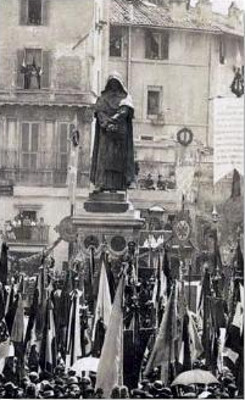
— Ill.: Statue af G. Bruno, Campo dei Fiori 1889. via wikimedia.org
— G. Bruno: Cabala del Cavallo Pegaseo, 1585