Virkeligheden er i høj grad noget overvurderet lort, fyldt med nævenyttige forskere, som med deres kedsommelige fakta formår at henlægge enhver fantasifuld, brutal, dramatisk, tragisk eller i det hele taget bare spændende historie til fantasiens eller myternes verden! Se nu for eksempel bare hvad Den Store Danske Encyklopædi skriver om tyrannen Falaris:
Falaris, d. ca. 554 f.Kr., tyran i Akragas, nuværende Agrigento i Italien. Historien om Falaris som en særlig brutal tyran, der ristede sine ofre levende i en bronzetyr, er tvivlsom. Akragas ser ud til at have blomstret i hans regeringstid.
Vi ser helt bort fra den moraliserende antagelse af, at (by)samfund ikke kan trives og blomstre under tyranners styre, og haster videre til nogle langt mere interessante kilder.
Cicero:
“Some ages afterwards, Publius Scipio took Carthage, in the third Punic war; after which victory, (remark the virtue and carefulness of the man, so that you may both rejoice at your national examples of most eminent virtue, and may also judge tire incredible audacity of Verres worthy of the greater hatred by contrasting it with that virtue,) he summoned all the Sicilians, because he knew that during a long period of time Sicily had repeatedly been ravaged by the Carthaginians, and bids them seek for all they had lost, and promises them to take the greatest pains to ensure the restoration to the different cities of everything which had belonged to them. Then those things which had formerly been removed from Himera, and which I have mentioned before, were restored to the people of Thermae; some things were restored to the Gelans, some to the Agrigentines; among which was that noble bull, which that most cruel of all tyrants, Phalaris, is said to have had, into which he was accustomed to put men for punishment, and to put fire under. And when Scipio restored that bull to the Agrigentines, he is reported to have said, that he thought it reasonable for them to consider whether it was more advantageous to the Sicilians to be subject to their own princes, or to be under the dominion of the Roman people, when they had the same thing as a monument of the cruelty of their domestic masters, and of our liberality.” (Cic. Ver. 2.4.73 / tr: C.D.Yonge)
Diodor:
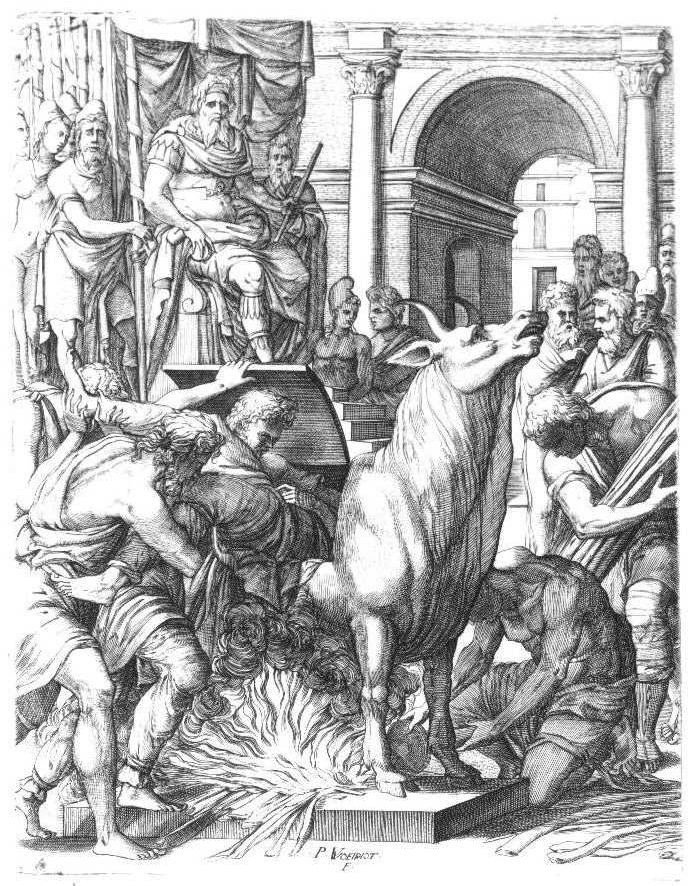
“This Phalaris burned to death Perilaus, the well-known Attic worker in bronze, in the brazen bull. Perilaus had fashioned in bronze the contrivance of the bull, making small sounding pipes in the nostrils and fitting a door for an opening in the bull’s side and this bull he brings as a present to Phalaris. And Phalaris welcomes the man with presents and gives orders that the contrivance be dedicated to the gods. Then that worker in bronze opens the side, the evil device of treachery, and says with inhuman savagery, “If you ever wish to punish some man, O Phalaris, shut him up within the bull and lay a fire beneath it; by his groanings the bull will be thought to bellow and his cries of pain will give you pleasure as they come through the pipes in the nostrils.” When Phalaris learned of this scheme, he was filled with loathing of the man and says, “Come then, Perilaus, do you be the first to illustrate this; imitate those who will play the pipes and make clear to me the working of your device.” And as soon as Perilaus had crept in, to give an example, so he thought, of the sound of the pipes, Phalaris closes up the bull and heaps fire under it. But in order that the man’s death might not pollute the work of bronze, he took him out, when half-dead, and hurled him down the cliffs.” (Diod. 9.19.1 / tr.: by C.H.Oldfather)
Lukian, som lægger ordene i munden på Falaris selv:
“And now I must explain to you the origin of my present offering, and the manner in which it came into my hands. For it was by no instructions of mine that the statuary made this bull: far be it from me to aspire to the possession of such works of art! A countryman of my own, one Perilaus, an admirable artist, but a man of evil disposition, had so far mistaken my character as to think that he could win my regard by the invention of a new form of torture; the love of torture, he thought, was my ruling passion. He it was who made the bull and brought it to me. I no sooner set eyes on this beautiful and exquisite piece of workmanship, which lacked only movement and sound to complete the illusion, than I exclaimed: “Here is an offering fit for the God of Delphi: to him I must send it.” “And what will you say,” rejoined Perilaus, who stood by, “when you see the ingenious mechanism within it, and learn the purpose it is designed to serve?” He opened the back of the animal, and continued: “When you are minded to punish any one, shut him up in this receptacle, apply these pipes to the nostrils of the bull, and order a fire to be kindled beneath. The occupant will shriek and roar in unremitting agony; and his cries will come to you through the pipes as the tenderest, most pathetic, most melodious of bellowings. Your victim will be punished, and you will enjoy the music.”(Luc. Phal. 1.11 / tr: Fowler)
Men musikken blev altså ikke rigtig påskønnet af tyrannen, som ikke bare syntes at Perilaus’ opfindsomhed var lige i overkanten, men ligefrem blev frastødt af den:
"‘His words revolted me. I loathed the thought of such ingenious cruelty, and resolved to punish the artificer in kind. “If this is anything more than an empty boast, Perilaus,” I said to him, “if your art can really produce this effect, get inside yourself, and pretend to roar; and we will see whether the pipes will make such music as you describe.” He consented; and when he was inside I closed the aperture, and ordered a fire to be kindled. “Receive,” I cried, “the due reward of your wondrous art: let the music-master be the first to play.” Thus did his ingenuity meet with its deserts. But lest the offering should be polluted by his death, I caused him to be removed while he was yet alive, and his body to be flung dishonoured from the cliffs. The bull, after due purification, I sent as an offering to your God, with an inscription upon it, setting forth all the circumstances; the names of the donor and of the artist, the evil design of the latter, and the righteous sentence which condemned him to illustrate by his own agonized shrieks the efficacy of his musical device.” (Luc. Phal. 1.11 / tr: Fowler)
… og endelig Pindar med en slags morale på den historie:
The kindly excellence of Croesus does not perish, but Phalaris, with his pitiless mind, who burned his victims in a bronze bull, is surrounded on all sides by a hateful reputation; lyres that resound beneath the roof do not welcome him as a theme in gentle partnership with the voices of boys. The first of prizes is good fortune; the second is to be well spoken of; but a man who encounters and wins both has received the highest garland.(Pind. Pyth. 1.94 / tr. D. A. Svarlien)
 En helt igennem vidunderlig men måske ikke særlig letlæst kilde til denne og andre fatasifulde historier i kategorien Sjov med Meningsløs Vold er Roland Villeneuves: La Musée des Supplices (Paris 1968) bogen findes også i tysk oversættelse, med den helt igennem vidunderlige titel:
“Grausamkeit und Sexualität. Sadistisch-flagellantische, pathologische, gesellschaftlich-machtpolitische und religiöse Hintergründe der Leibes- und Todesstrafen, Hinrichtungsarten, Martern und Qualen bis in die Gegenwart in Wort und Bild.” (Stuttgart 1968)
Bogen, som har en noget dyster og letkøbt påstand af Rivarol som motto: “Die zivilisierten Völker sind für das Gift der Barbarei so anfällig wie das blanke Eisen für den Rost. Völker und Stahl, beide glänzen nur an die Oberfläche.” anbefales kraftigt til nysgerrige men ikke alt for sarte sjæle.