UTI: Eros

Phryne

Phryne Phryne (φρύνη), var en græsk hetære, kendt for sin enestående skønhed, (“even in those parts of her person which were not generally seen“) rigdom og ikke mindst for retsagen mod hende, hvor hun blev forsvaret af sin elsker, oratoren Hypereides, som, da sagen så ud til at skulle tabes, hev tøjet af hende foran dommerne på Areopagos og lod hendes skønhed fylde dem med overtroisk frygt og selvfølgelig bevæge dem så meget, at de da slet ikke nænnede at dømme hende, dette levende billede på Venus, til døden. Phryne, som egentlig hed Mnesaréte (Μνησαρέτη) men havde tilnavnet phryne, som betyder tudse – et tilnavn ofte givet til prostituerede og lign. – levede i det fjerde århundrede f.v.t. og er omtalt hos Plutarch og Pausanias og flere andre og ikke mindst hos Athenaeus (samtidig med Marcus Aurelius), som femhundrede år og hel del sladder senere fortæller følgende anekdoter:
Phryne

Now Phryne was a native of Thespiæ; and being prosecuted by Euthias on a capital charge, she was acquitted: on which account Euthias was so indignant that he never instituted any prosecution afterwards, as Hermippus tells us. But Hyperides, when pleading Phryne’s cause, as he did not succeed at all, but it was plain that the judges were about to condemn her, brought her forth into the middle of the court, and, tearing open her tunic and displaying her naked bosom, employed all the end of his speech, with the highest oratorical art, to excite the pity of her judges by the sight of her beauty, and inspired the judges with a superstitious fear, so that they were so moved by pity as not to be able to stand the idea of condemning to death “a prophetess and priestess of Venus.” And when she was acquitted, a decree was drawn up in the following form: “That hereafter no orator should endeavour to excite pity on behalf of any one, and that no man or woman, when impeached, shall have his or her case decided on while present.”
Aphrodite

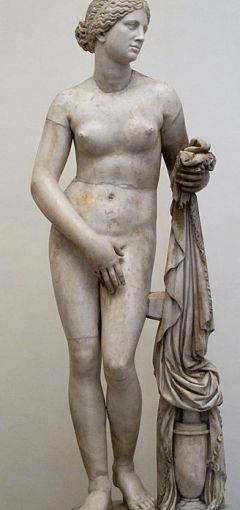
But Phryne was a really beautiful woman, even in those parts of her person which were not generally seen: on which account it was not easy to see her naked; for she used to wear a tunic which covered her whole person, and she never used the public baths. But on the solemn assembly of the Eleusinian festival, and on the feast of the Posidonia, then she laid aside her garments in the sight of all the assembled Greeks, and having undone her hair, she went to bathe in the sea; and it was from her that Apelles took his picture of the Venus Anadyomene; and Praxiteles the statuary, who was a lover of hers, modelled the Cnidian Venus from her body; and on the pedestal of his statue of Cupid, which is placed below the stage in the theatre, he wrote the following inscription:—

Praxiteles has devoted earnest care
To representing all the love he felt,
Drawing his model from his inmost heart:
I gave myself to Phryne for her wages,
And now I no more charms employ, nor arrows,
Save those of earnest glances at my love.

And he gave Phryne the choice of his statues, whether she chose to take the Cupid, or the Satyrus which is in the street called the Tripods; and she, having chosen the Cupid, consecrated it in the temple at Thespiæ. And the people of her neighbourhood, having had a statue made of Phryne herself, of solid gold, consecrated it in the temple of Delphi, having had it placed on a pillar of Pentelican marble; and the statue was made by Praxiteles. And when Crates the Cynic saw it, he called it “a votive offering of the profligacy of Greece.” And this statue stood in the middle between that of Archidamus, king of the Lacedæmonians, and that of Philip the son of Amyntas; and it bore this inscription— “Phryne of Thespiæ, the daughter of Epicles,” as we are told by Alcetas, in the second book of his treatise on the Offerings at Delphi. (1)

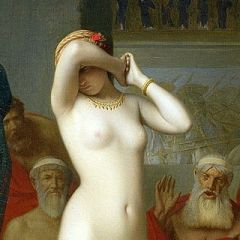
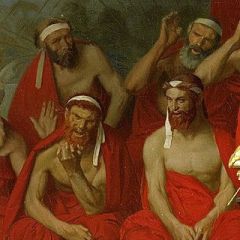
Alt dette er selv følgelig intet andet end en undskyldning for at gøre opmærksom på Jean-Léon Gérômes maleri Phryné devant l’Areopage fra 1861. Gérômes sans for detaljer kommer i den grad til udtryk i ansigterne på de forsamlede og maleriet indeholder i øvrigt en vidunderlig blanding af komik og drama og – ikke at forglemme – kvindelig skønhed, som vi herfra kun kan bifalde på det kraftigste.
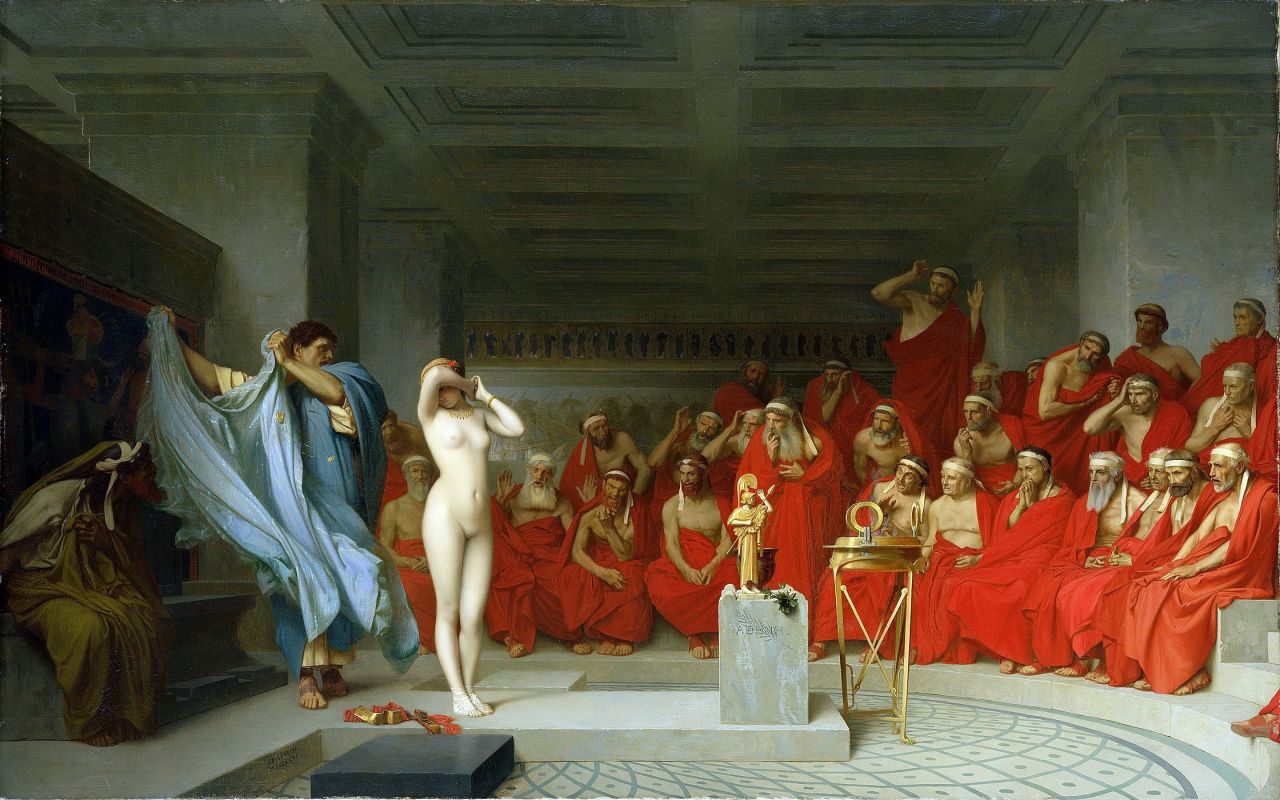
Image without description

Athenaeus:

But Apollodorus, in his book on Courtesans, says that there were two women named Phryne, one of whom was nicknamed Clausigelos,1 and the other Saperdium. But Herodicus, in the sixth book of his Essay on People mentioned by the Comic Poets, says that the one who is mentioned by the orators was called Sestos, because she sifted and stripped bare all her lovers; and that the other was the native of Thespiæ. But Phryne was exceedingly rich, and she offered to build a wall round Thebes, if the Thebans would inscribe on the wall, “Alexander destroyed this wall, but Phryne the courtesan restored it;” as Callistratus states in his treatise on Courtesans. And Timocles the comic poet, in his Neæra, has mentioned her riches (the passage has been already cited); and so has Amphis, in his Curis. And Gryllion was a parasite of Phryne’s, though he was one of the judges of the Areopagus; as also Satyrus, the Olynthian actor, was a parasite of Pamphila. But Aristogiton, in his book against Phryne, says that her proper name was Mnesarete; and I am aware that Diodorus Periegetes says that the oration against her which is ascribed to Euthias, is really the work of Anaximenes. But Posidippus the comic poet, in his Ephesian Women, speaks in the following manner concerning her:—

Before our time, the Thespian Phryne was
Far the most famous of all courtesans;
And even though you’re later than her age,
Still you have heard of the trial which she stood.
She was accused on a capital charge
Before the Heliæa, being said
To have corrupted all the citizens;
But she besought the judges separately
With tears, and so just saved herself from judgment.(2)


(1) (2) Athenaeus, Deipnosophistae 13.60, ovrs: C. D. Yonge 1854. (via Perseus)

Brøndgarnet

There was a young damsel named Baker
Who was poked in a pew by a Quaker.
He yelled, “My God! What
Do you call this – a twat?
Why, the entrance is more than an acre! (1)

There was a fat lady of China
Who’d a really enormous vagina,
And when she was dead
They painted it red,
And used it for docking a liner. (2)

Information bragte i weekenden 26-27. april 2015 en artikel om hårmode under den i øvrigt noget besynderlige overskrift “Brøndgarnet er på vej tilbage”, hvori forfatter Merete Pryds Helle er citeret for følgende:

“Hvis jeg vil have sex med kvinder, vil jeg også gerne have, at der ikke er hår. Ellers er det besværligt. Man kan jo ikke finde rundt. Men hvis andre synes hår er sexet, så fint nok. Så er vi bare forskellige på det område.”

L'Origine du Monde Besværligt at finde rundt i? Virkelig? Man tør næsten ikke spørge til størrelsen på disse organer som Frk. Helle fordyber sig i, men foretrækker i stedet at konstatere, at der åbenbart hos hende er er visse problemer med selverkendelsen.

Det er ellers Frk. Helle, der – ifølge selv samme artikel – “peger på et overset paradoks ved det store rasende debat om den behårede trekant: Selv for dem, der mener at være feminister, handler det hele tiden om det mandlige blik på kvindekønnet i stedet for, hvordan det føles indefra.” For, som Frk. Helle siger “De siger jo ikke at det er godt for for sexlivet at have hår. De taler om, hvor vidt manden ser dem som en lille pige. Jeg er ligeglad med blikket. Jeg er kun interesseret i, hvad jeg føler og mærker.”

Bortset fra at Frk. Helle sagtens kan være ligeglad med “blikket” fra mænd, når hendes eget ærinde tilsyneladende er at have sex med kvinder, så er det da påfaldende at hun, der så frejdigt gennemskuer andres manglende erkendelse af egne motiver, selv dækker sine egne behov for at følge mode og ydre påvirkning bag absurde bortrationaliseringer, som at en smule behåring skulle gøre det svært at "finde rundt". (I samme kategori er den også ofte hørte og ikke mindre tåbelige indvending: “Hvem gider at have hår i maden?“)

There once was a Queen of Bulgaria
Whose bush had grown hairier and hairier,
Till a Prince from Peru
Who came up for a screw
Had to hunt for her cunt with a terrier. (1)


— “Brøndgarnet er på vej tilbage”, Information, d. 26/4 2015
(1)(2)(3) Limericks via G. Legman: The Limerick. (N.Y. 1991) #128, #138 og #141. Se evt også #246: There was a young lady whose thighs, / When spread showed a slit of such size, / And so deep and so wide, / You could play cards inside, / Much to her bridegroom’s surprise.
Ill: Gustave Courbet: L’Origine du Monde (1866)

Eros VI

Johanne Louise Heiberg:

Det lette, muntre Sind gjorde hende uforsigtig i sine Ytringer, det varme Hjerte henrev hende til at lytte til den Elskovsrøst, hvoraf hele hendes Kvindenatur var gjennemstrømmet, uden at det faldt i den Ulykkeliges Lov at møde Een, der kunde forvandle Eros til Apollon og give hendes hele Væsen en høiere Retning. Det religiøse Element hos hende var atter her kun som hos den unge, umiddelbare Kvinde, der holder fast ved Guds Barmhjertighed uden at have arbeidet hen mod, hvad Gud kræver af Lydighed og Forsagelse, og den katholske Lære med sin Syndsforladelse gjorde hende tryg for Følgerne af hendes Overtrædelser.(1)

Ernesto Dalgas:

Atter er Eros kommet til Verden for at forme Kosmos ud af Kaos. Og atter skal han leve et Liv og elske og drømme og føle sig salig og gaa under i Ildsvælget uden at vide, at dette er sket utallige Gange før. (2)

Sofokles:

O Eros! Alsejrer i Strid! Du styrter mod bævende Bytte; paa Møens grubede bløde Kinder lurende du dig dølger. Hen over Havet iler du, naaer Hyrdernes lave Hytte. Ej undflyr udødelig Gud, hvor du følger, og ingen paa Jord af Dagens Børn. Den, der har dig, raser.(3)


(1) Johanne Louise Heiberg: Et liv gjenoplevet i erindringen (1944), bd. 3, s.115. (om Maria Stuart) (2) Ernesto Dalgas: Dommedags bog.(s. 283) (3) Sofokles: Antigone. Overs.: Niels Møller.

Eros V

Midt i Kampens Lyn og Torden,
Midt i Verdens vilde Stræben,
Svæver Eros over Jorden
Trøstig med sit Smil paa Læben:

Hvor det milde Blik han hæfter,
Seer han Mørkets Aander række
Mennesket de skjulte Kræfter
For at myrde, ødelægge!

Men mod Alt, hvormed de true –
Projectiler, Staaldæmoner,
Sætter han sin gyldne Bue,
Sigtende mod alle Zoner –

Sætter han de varme Blikke,
Naar en Qvinde kjærligt smiler –
Anden Ild han bruger ikke,
Det er Gudens Projectiler.

Blødt, som Vox, hensmelter Staalet,
Tifold selv om Hjertet smedet,
Naar hans Øje søger Maalet,
Og hans Haand har Pilen ledet.

Ja, for Hver, som sank til Hvile,
– Livet slukt i Krigens Jammer –
Sender Eros tusind Pile,
Tænder tusind nye Flammer!

Skal end længe Jordens Stjerne,
Som sig fast i Vanvid drejer,
Fra Lyksalighed sig fjerne,
Blind for al det Held, den ejer –

Sikkert Timen dog oprinder,
Ihvor giftigt Slangen hvisler,
Da hans Rose overvinder
Alle Jordens fæle Tidsler!


— Ludvig Bødtcher: Samlede Digte s. 183-4

Eros IV

Nonne

En Nat — en Nat i Favntag kun
paa Eros’ Purpurleje,
et Nu — et Nu af Evighed
jeg vil din Ungdom eje.

Og har jeg klædt i Kys og Ild
de nøgne Jomfrulemmer
og brændt mit Billed i din Sjæl,
saa du det aldrig glemmer,

— saa tag dit Lin, dit sorte Lin
og klæd dig paa som Nonne
og hæft et Slør for Øjets Glød
og for din friske Aande.

Og lad dit Legems hvide Kød
Askesens Skumring blinde,
og dine Lokkers sorte Pragt
bag Dødninglin forsvinde.

Kun dine Bryn — de stolte Bryn
som lange smale Vinger
skal give Blikket Himmelflugt,
der mig i Støvet tvinger.

Din Mund — din faste røde Mund
skal stivne stum og stille,
og aldrig mer et Længselssmil
om dine Læber spille.

Din Haand — din hvide varme Haand,
den bløde Kærtegnsvifte,
skal isne mig foran dig ned
og tvinge mig til Skrifte.

Og Tugt skal strømme fra dit Blik
og Kirkens store Kulde —
og aldrig nogen Stemning mer
dit Blod i Bølger rulle.

Da vil jeg knæle for din Fod
og stivnes af dit Øje
— og vi mit Liv til Bøn og Bod,
Madonna i det Høje!


— Sophus Michaelis: Solblomster s. 133-4

Eros III

AQVILINUS.
– Frydes ved din Skjønhed
og sige mandig Dig, foruden Omsvøb:
Jeg har Dig kjær!

FULVIA (undvigende).
Hvis jeg besidder Skjønhed,
som Du og Fler behage det at sige,
da – tro mig – selv jeg skatter den kun lidt;
den er forgjængelig, men Aanden lever,
kun den besejrer Tiden, kjender ej
til Alder eller Kjøn!

AQVILINUS.
Du glemmer der,
at selv hos de udødelige Guder
gjør Kjønnet Forskjel mellem Mand og Kvinde;
den høje Tordner Zevs har sin Gudinde.

FULVIA.
Ja han har mange flere, vil man sige,
og har, som vel Du véd, sin store Plage,
thi Hera skal jo være meget skinsyg
og ofte kives med sin Ægtemage.

AQVILINUS.
Spøg ej med den guddommelige Ild,
men husk, at Eros’ Rige Alt omfatter:
Himmel og Jord!

FULVIA.
Ja, han gjør Mænd til Latter
og driver selv med Guderne sit Spil!

AQVILINUS.
Den, som kan trodse ham , er ikke til!


— H. V. Kaalund: Fulvia. Drama I Fem Akter. Kjøbenhavn, 1891

Eros II

“Det er Eros, som har Æren for al Skaben og nydannelse i Verden. Det er ganske simpelt Platons og Hellenernes Eros.”(1)

“Eros er ikke et udelukkende positivt begreb; der findes ‘smuk’ og ‘forkastelig’ eros, og det var den almindelige opfattelse, at det er både vulgært og forkasteligt, hvis eros kun består af ren og skær tilfredsstillelse af et fysisk behov. Det er et udtryk for den enkeltes gode eller dårlige karakter, om et erotisk forhold er smuk eller forkasteligt; der er ikke nogen moralsk skelnen imellem eros mellem de to køn og eros mellem to af samme køn.”


(1) Sophus Claussen: Notater og Skitser, København 1993. S. 106
(2) R. Sevelsted & C. G. Tortzen i forordet til Platons Symposion, I: Platon: Samlede værker i ny oversættelse, bind II. København 2010. s. 307

Eros I

“As erôs is an invasive force from outside, its presence can be shaming and disorienting, in that it takes away one’s better judgment and one’s sense of independence; erôs forces us to confront our lack and need […]. Erôs, moreover, regularly forces people to do things which they, in more considered moments, know to be wrong or socially disapproved; it is traditionally an irrational power which works against the better counsels of reason.”


— Richard Hunter: Plato’s Symposium. Oxford 2004. s.17

Eros

I en gymnastiksal i Athen for knap 2500 år siden:

Yesterday evening I returned from the army at Potidaea, and having been a good while away, I thought that I should like to go and look at my old haunts. So I went into the palaestra of Taureas, which is over against the temple adjoining the porch of the King Archon, and there I found a number of persons, most of whom I knew, but not all. My visit was unexpected, and no sooner did they see me entering than they saluted me from afar on all sides; and Chaerephon, who is a kind of madman, started up and ran to me, seizing my hand, and saying, How did you escape, Socrates?—(I should explain that an engagement had taken place at Potidaea not long before we came away, of which the news had only just reached Athens.)

– You see, I replied, that here I am.

– There was a report, he said, that the engagement was very severe, and that many of our acquaintance had fallen.

– That, I replied, was not far from the truth.

– I suppose, he said, that you were present.

– I was.

– Then sit down, and tell us the whole story, which as yet we have only heard imperfectly.

I took the place which he assigned to me, by the side of Critias the son of Callaeschrus, and when I had saluted him and the rest of the company, I told them the news from the army, and answered their several enquiries.

He proceeds to make enquiries about the state of philosophy and about the youth; and is told of the beautiful Charmides,

Then, when there had been enough of this, I, in my turn, began to make enquiries about matters at home—about the present state of philosophy, and about the youth. I asked whether any of them were remarkable for wisdom or beauty, or both. Critias, glancing at the door, invited my attention to some youths who were coming in, and talking noisily to one another, followed by a crowd. Of the beauties, Socrates, he said, I fancy that you will soon be able to form a judgment. For those who are just entering are the advanced guard of the great beauty, as he is thought to be, of the day, and he is likely to be not far off himself.

– Who is he, I said; and who is his father?

– Charmides, he replied, is his name; he is my cousin, and the son of my uncle Glaucon: I rather think that you know him too, although he was not grown up at the time of your departure.

– Certainly, I know him, I said, for he was remarkable even then when he was still a child, and I should imagine that by this time he must be almost a young man.

– You will see, he said, in a moment what progress he has made and what he is like. He had scarcely said the word, when Charmides entered.

– Now you know, my friend, that I cannot measure anything, and of the beautiful, I am simply such a measure as a white line is of chalk; for almost all young persons appear to be beautiful in my eyes. But at that moment, when I saw him coming in, I confess that I was quite astonished at his beauty and stature; all the world seemed to be enamoured of him; amazement and confusion reigned when he entered; and a troop of lovers followed him. That grown–up men like ourselves should have been affected in this way was not surprising, but I observed that there was the same feeling among the boys; all of them, down to the very least child, turned and looked at him, as if he had been a statue.

Chaerephon called me and said: What do you think of him, Socrates? Has he not a beautiful face?

– Most beautiful, I said.

– But you would think nothing of his face, he replied, if you could see his naked form: he is absolutely perfect.

And to this they all agreed.

– By Heracles, I said, there never was such a paragon, if he has only one other slight addition.

– What is that? said Critias.

– If he has a noble soul…

(Char. 153a-154e. Overs: Jowett)

… og efter at have konstateret at skønheden (også) kommer indefra, beslutter Sokrates sig for at lege doktor med de unge drenge:

– Then, before we see his body, should we not ask him to show us his soul, naked and undisguised? he is just of an age at which he will like to talk.

– That he will, said Critias, and I can tell you that he is a philosopher already, and also a considerable poet, not in his own opinion only, but in that of others.

– That, my dear Critias, I replied, is a distinction which has long been in your family, and is inherited by you from Solon. But why do you not call him, and show him to us? for even if he were younger than he is, there could be no impropriety in his talking to us in the presence of you, who are his guardian and cousin.

– Very well, he said; then I will call him; and turning to the attendant, he said, Call Charmides, and tell him that I want him to come and see a physician about the illness of which he spoke to me the day before yesterday. Then again addressing me, he added: He has been complaining lately of having a headache when he rises in the morning: now why should you not make him believe that you know a cure for the headache?

– Why not, I said; but will he come?

– He will be sure to come, he replied.

(Char. 154e-b Overs: Jowett)

… og får sig et glimt af skønheden:

He [Charmides] came as he was bidden, and sat down between Critias and me. Great amusement was occasioned by every one pushing with might and main at his neighbour in order to make a place for him next to themselves, until at the two ends of the row one had to get up and the other was rolled over sideways. Now I, my friend, was beginning to feel awkward; my former bold belief in my powers of conversing with him had vanished. And when Critias told him that I was the person who had the cure, he looked at me in such an indescribable manner, and was just going to ask a question. And at that moment all the people in the palaestra crowded about us, and, O rare! I caught a sight of the inwards of his garment, and took the flame. Then I could no longer contain myself. I thought how well Cydias understood the nature of love, when, in speaking of a fair youth, he warns some one ‘not to bring the fawn in the sight of the lion to be devoured by him,’ for I felt that I had been overcome by a sort of wild–beast appetite.

(Char. 155c-e Overs: Jowett)

I Symposion er det den unge smukke Alkibiades som Sokrates har rettet sin interesse mod, men det er den unge mand, som bliver skuffet:

When the lamp was put out and the servants had gone away, I thought that I must be plain with him and have no more ambiguity. So I gave him a shake, and I said:

‘Socrates, are you asleep?’

‘No,’ he said.

‘Do you know what I am meditating?’

‘What are you meditating?’ he said.

‘I think,’ I replied, ‘that of all the lovers whom I have ever had you are the only one who is worthy of me, and you appear to be too modest to speak. Now I feel that I should be a fool to refuse you this or any other favour, and therefore I come to lay at your feet all that I have and all that my friends have, in the hope that you will assist me in the way of virtue, which I desire above all things, and in which I believe that you can help me better than any one else. And I should certainly have more reason to be ashamed of what wise men would say if I were to refuse a favour to such as you, than of what the world, who are mostly fools, would say of me if I granted it.’

To these words he replied in the ironical manner which is so characteristic of him:

‘Alcibiades, my friend, you have indeed an elevated aim if what you say is true, and if there really is in me any power by which you may become better; truly you must see in me some rare beauty of a kind infinitely higher than any which I see in you. And therefore, if you mean to share with me and to exchange beauty for beauty, you will have greatly the advantage of me; you will gain true beauty in return for appearance—like Diomede, gold in exchange for brass. But look again, sweet friend, and see whether you are not deceived in me. The mind begins to grow critical when the bodily eye fails, and it will be a long time before you get old.’

Hearing this, I said:

‘I have told you my purpose, which is quite serious, and do you consider what you think best for you and me.’

‘That is good,’ he said; ‘at some other time then we will consider and act as seems best about this and about other matters.’

Whereupon, I fancied that he was smitten, and that the words which I had uttered like arrows had wounded him, and so without waiting to hear more I got up, and throwing my coat about him crept under his threadbare cloak, as the time of year was winter, and there I lay during the whole night having this wonderful monster in my arms. This again, Socrates, will not be denied by you. And yet, notwithstanding all, he was so superior to my solicitations, so contemptuous and derisive and disdainful of my beauty—which really, as I fancied, had some attractions—hear, O judges; for judges you shall be of the haughty virtue of Socrates—nothing more happened, but in the morning when I awoke (let all the gods and goddesses be my witnesses) I arose as from the couch of a father or an elder brother.

What do you suppose must have been my feelings, after this rejection, at the thought of my own dishonour? And yet I could not help wondering at his natural temperance and self–restraint and manliness. I never imagined that I could have met with a man such as he is in wisdom and endurance. And therefore I could not be angry with him or renounce his company, any more than I could hope to win him. For I well knew that if Ajax could not be wounded by steel, much less he by money; and my only chance of captivating him by my personal attractions had failed. So I was at my wit’s end; no one was ever more hopelessly enslaved by another.

(Symposion 218c-219e Overs: Jowett)

På dansk

Kære Alkibiades! Du er vist ikke så tosset endda, hvis det virkelig er sandt, hvad du siger om mig, og der er en eller anden kraft i mig, som kan gøre dig bedre. Du må se en ufattelig skønhed i mig, fuldstændig forskellig fra dit eget smukke udseende. Hvis du har fået kig på den og prøver at slå en handel af og bytte skønhed for skønhed, så regner du med at få en del mere ud af det end jeg. Til gengæld for en tilsyneladende skønhed prøver du at skaffe dig den sande skønhed, ja du har faktisk i sinde ‘for en gylden’ at bytte dig til ‘en rustning af bronze’.(1)

Men kære ven, pas hellere på, at jeg ikke narrer dig ved ikke at være noget værd. Tankens klarsyn skærpes først, når øjnene så småt taber deres evne til at se. Og det er du stadig langt fra.(2)

Rasmus Sevelsted skriver følgende om ‘eros’ i forordet til andet bind af den nye Platon-oversættelse:

Eros er ikke et udelukkende positivt begreb; der findes ‘smuk’ og ‘forkastelig’ eros, og det var den almindelige opfattelse, at det er både vulgært og forkasteligt, hvis eros kun består af ren og skær tilfredsstillelse af et fysisk behov. Det er et udtryk for den enkeltes gode eller dårlige karakter, om et erotisk forhold er smuk eller forkasteligt; der er ikke nogen moralsk skelnen imellem eros mellem de to køn og eros mellem to af samme køn.(3)


(1) jvf Iliaden VI.235
(2) Platon: Samlede værker i ny oversættelse, bind II. København 2010. s. 378
(3) Platon; Samlede værker i ny oversættelse, bind II. København 2010. s. 307

A propos blasfemi

I disse tider hvor alle taler om hensynet til muslimers religiøse følelser, så bragte Weekend Avisen i fredags dette maleri af Félicien Rops, i en omtale af en udstilling på Gl. Holtegaard:

Image without description

Gad nok vide hvorfor der ikke er nogen der siger noget til det?